What is amah al amah
Amah al amah ("a cubit by a cubit") is a small area of a wall in the home that is left without plaster or paint, as a reminder of the destruction of the Temple. Its meaning is simple and strong: even in the most beautiful home, something is missing. Until the Temple is rebuilt, our home is not complete.
The custom is also called zecher lachurban, a remembrance of the destruction, and is one of several customs the sages instituted so that Jerusalem stays present in daily life.
The source: Talmud and Shulchan Aruch
The source is in the Talmud, tractate Bava Batra (60b). It says a person may plaster his home but should leave a small area bare; Rav Yosef gives the measure as a cubit by a cubit, and Rav Chisda adds that it should be opposite the entrance.
This was codified as law in the Shulchan Aruch:
Since the Temple was destroyed, the sages decreed that one should never build a plastered and decorated building like the buildings of kings; rather one plasters his house with mortar and lime, and leaves an area of a cubit by a cubit opposite the entrance without plaster.
Shulchan Aruch, Orach Chaim 560:1
How big is an amah al amah in centimeters
An amah is a biblical unit of length, and authorities differ on its modern equivalent. According to Rabbi Chaim Na’eh it is about 48 cm; according to the Chazon Ish, about 58 cm.
The common size is therefore a square of 48 by 48 cm, and some make it larger to satisfy all opinions.
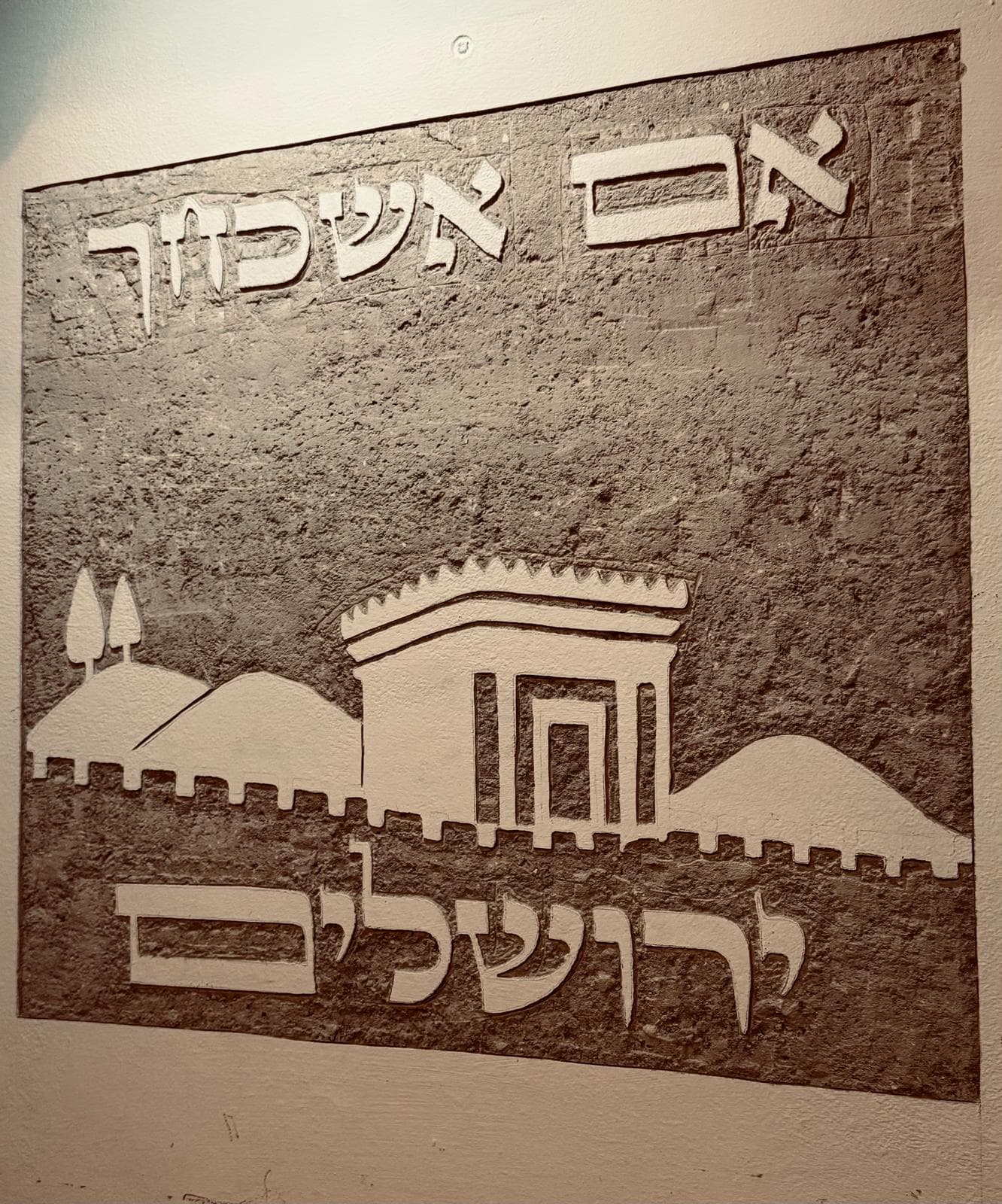
Where the amah al amah is placed
According to the Talmud and Shulchan Aruch it goes "opposite the entrance": on the wall facing the front door, so it is seen immediately on entering the home. That is why the custom works so well. It is not hidden in a corner; it meets us every day.
When the entrance wall is not suitable, because of a window, a cabinet or wiring, the nearest wall visible from the entrance is usually chosen.
Can you make one in an existing home?
Yes. In most homes the walls are already plastered and painted, so the existing wall is exposed: plaster and paint are removed over an area of a cubit by a cubit, down to the concrete or block beneath.
This is exactly where the memory can become a work of art. Instead of a bare grey square, the concrete is hand-carved with the Temple, the walls of Jerusalem, or a verse such as "If I forget you, Jerusalem".
Amah al amah as a work of art
At Measure of Memory we expose the concrete by hand and carve into it traditional images, inscriptions and ornaments inspired by Judaism, Jerusalem and the Temple. Every piece is planned with the family, fitted to the wall and the home, and made on site in one to two days.
See the pieces we have made across Israel and the designs you can choose from.
This guide is general information, not a halachic ruling. For specific questions, for example in a rented home or one bought already plastered, please consult a rabbi.
Last updated · October 2026